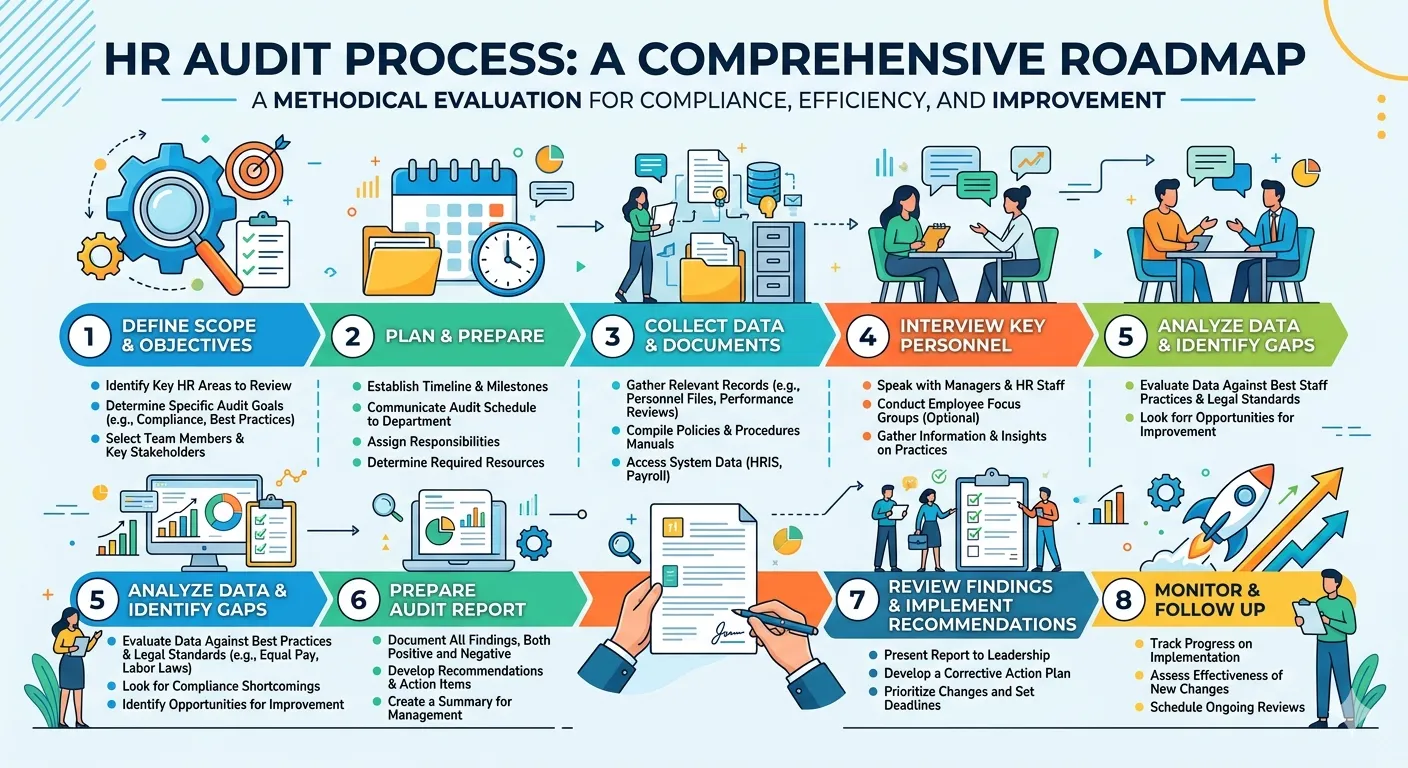
The HR Audit

The structured way a seller finds out what a buyer will find.

The employment position of a business gets reviewed properly once, and in most cases it is a buyer's advisers who do it. Contracts drafted for a business three sizes ago, policies that describe a process nobody follows, a contractor population whose status has never been tested, a grievance that was closed by the individual leaving rather than by the matter being resolved: none of it is unusual, and all of it is discoverable.

The seller almost always knows something is there. What the seller does not have, at the point a buyer's counsel raises it in week three of exclusivity, is any time to do something about it, and no position from which to argue.

The audit moves that discovery forward, to the point where a finding is still a decision rather than a discount.

What this means

The audit is a structured, independent review of how a business manages its people: legally, operationally, and commercially. The subject matter is the same seven areas a buyer's advisers will work through — contracts, policies, statutory compliance, disciplinary and grievance procedure, records, governance, and liabilities — and the review goes past the documentation to what the business actually does, because that is the gap the diligence sampling exists to find.

What differs is the output. Each finding is stated, quantified where quantification is possible, and rated twice: for the likelihood that a buyer reaches it, and for what it is likely to cost if they do. Some findings are worth fixing and some are worth disclosing well, and the report says which is which. For a business heading towards a process, this is the entry point to the sell-side work; for a business that is not, it is still the most complete picture of its employment position it is likely to have.

What we look at

The same territory a buyer's employment counsel works through, reviewed in the same order, with the same question in mind.

  • Employment contracts and documentation

    Do the contracts say what the business needs them to say, and would the restrictive covenants on the senior population survive a challenge a buyer will assume is coming?

  • HR policies and employee handbook

    Whether the policies meet current legislation, and whether they describe what the business actually does. A buyer's counsel will sample both.

  • Compliance with UK employment law

    Position against current obligations, including the Employment Rights Act 2025, and the cost of the gap where one exists.

  • Recruitment, onboarding and employment status

    Right-to-work records, offer documentation, and the contractor and consultant population whose employment status has usually never been tested.

  • Disciplinary and grievance procedures

    Whether the record would withstand cross-examination, and what a sample of the last two years of case files would tell a buyer about how the business handles risk.

  • Absence and performance management

    Consistency of practice, documentation, and the pattern that emerges when the same manager's decisions are read together rather than one at a time.

  • Data protection and HR record-keeping

    Obligations under UK GDPR, and whether the records exist in a form that can be produced to a data room inside a fortnight.

  • Management capability and HR governance

    Who is making employment decisions, on what authority, and whether the oversight would satisfy a buyer that the exposure is contained.

  • Risk exposure and quantified liabilities

    Holiday pay, working time, historic TUPE positions, live and threatened claims: each sized where it can be sized, and flagged where it cannot.

Who commissions it

Owners and boards twelve to twenty-four months out from a sale, sponsors establishing a baseline at the start of a hold period or preparing a portfolio company for a process, and acquirers who have inherited an entity whose employment position was never independently reviewed.

The timing argument is the whole of it. The analysis takes weeks; the remediation takes quarters. Contracts can be reissued in a month, but a three-year pattern of inconsistent practice cannot be reversed retrospectively, a senior matter cannot be concluded on a transaction's timetable without the individual noticing what the deadline is worth to them, and a comp structure cannot be rebased quickly enough for the rebase not to become a finding in its own right.

Businesses with no transaction in view commission it too, and get the same report. They simply use it to run the business rather than to sell it.

When businesses typically come to us

There are patterns, and most of them are governed by a date somewhere in the future.

  • Twelve to twenty-four months before an intended sale or investment process
  • At the start of a hold period, to establish the baseline the exit will be measured against
  • Following an acquisition, where the acquired entity's position has never been independently reviewed
  • After a tribunal claim, grievance, or near-miss that suggested the practice is not what the handbook describes
  • Following a change in leadership or the departure of the person who held the HR knowledge
  • Where a prior TUPE transfer left two populations on different terms and nobody has quantified it
Structured document review as part of an independent HR audit

How it works

Briefing

We start with a conversation. We discuss your business, your concerns, and what you want the review to focus on. We agree the scope, the timeline, and the practicalities. No lengthy proposals. No unnecessary process.

Review

We assess your documentation, your processes, and your practice. We speak to the people who need to be spoken to. We look at how things actually operate day to day, not just what is written in the handbook. This is where the real findings surface.

Report and recommendations

You receive a clear, prioritised report covering every area we reviewed. Each finding is rated by risk level, with practical recommendations for what to do next. We talk you through it and agree the next steps.

What you get

A document written to be handed to a board, an adviser, or a sponsor without translation.

  • A written report covering every area reviewed, with each finding rated for the likelihood a buyer will reach it and the likely effect on price or structure
  • Quantification of the exposures that can be sized, and an explicit statement of the ones that cannot
  • A remediation route for each finding, with a realistic timeline attached to it
  • A view on what is better disclosed and framed than fixed, and how to frame it
  • Commentary on the contracts and policies themselves, not a checklist against a template
  • A session with the board, the owner, or the sponsor to work through the findings and agree the sequence

And a position. Not a score, but a documented view of where the business stands and what it intends to do about each item before anyone else asks.

How this looks in practice

A founder-led technology business with 60 employees, two years from a sale

The founders had built the business quickly and hired well, without much employment infrastructure behind it. Contracts had been copied from a template five years earlier and never revisited. There was no handbook. Managers had handled several performance situations inconsistently, and nineteen people were engaged as contractors on terms that had never been tested.

The review identified eleven areas of material exposure. Three were rated as likely to reach a buyer and likely to attach to price: the contractor population, an absent disciplinary framework against a documented history of informal dismissals, and restrictive covenants that would not have been enforced against the two commercial leads the growth plan depended on.

Contracts were reissued and a policy suite put in place inside three months. Twelve of the contractors were brought onto employment contracts and the historic exposure was quantified and provided for. Both commercial leads were moved onto enforceable terms as part of a wider comp change rather than as an isolated request, which is why they signed. The work completed fourteen months before the process opened.


A PE-backed services business preparing for exit

The board knew that buyer due diligence would include a detailed review of people risk. They had been through a period of rapid growth, and HR had not kept pace. Contracts varied across the workforce. Policies existed but had not been reviewed since acquisition. There had been a grievance six months earlier that was handled poorly and never properly resolved.

Esbee was brought in to conduct an HR compliance audit ahead of the planned sale process. The review surfaced risks that the board had not been aware of, including potential exposure on holiday pay calculations and inconsistencies in restrictive covenant clauses across senior contracts.

The findings were addressed before the process began, removing objections that could have affected valuation or delayed completion. The board entered due diligence with a clean position and full visibility of their HR landscape.

Frequently asked questions

How long does an HR audit take?

Two to four weeks from briefing to final report for a single-entity business, longer where there are multiple entities, a prior transaction in the history, or an unusually large contractor population. The timeline is agreed at briefing and worked to.

How much does it cost?

Fixed fee, quoted once the scope is understood. Scope is driven by headcount, the number of entities, and whether the business has been through a transaction before. There is no hourly component and no open-ended billing.

How is this different from a compliance check?

A compliance check tells a business whether it is currently breaking the law. The audit asks a different question: what a buyer's advisers will find when they look, what they will do with it, and what it is likely to cost. Several of the most expensive findings in a diligence process are not breaches at all — a covenant that would not be enforced, a comp structure that will not survive alignment, a contractor population whose status has never been tested — and a compliance review is not looking for them.

Do we need to be selling for this to be worth doing?

No, and a good proportion of the businesses that commission it have no immediate process in view. The framing still holds: an owner who intends to sell at some point is better served by knowing now than by finding out in exclusivity, and the remediation is cheaper and less disruptive when there is no timetable pressing on it. Businesses that are not selling get the same report and use it differently.

What happens after we receive the report?

That is the seller's decision. Some businesses commission the remediation from Esbee — contracts reissued, policies rebuilt, exposures closed out, senior matters concluded — and some use the report to brief their own team or their employment lawyers. There is no obligation to proceed beyond the audit, and the report is written to be usable by someone else.

When in a PE hold period is this most useful?

Twice. At the start, to establish the baseline that the exit will eventually be measured against and to catch anything inherited from the previous owner that has not been looked at. And twelve to twenty-four months before the intended exit, as the entry point to the vendor due diligence work, when there is still time to fix what the review finds.

The practice is led by Sam Bramhall.

Sam Bramhall is the Principal Consultant at Esbee, with two decades of board-level strategic HR and organisational advisory across telecoms, fintech, professional services, technology, and PE-backed businesses. Engagements are principal-led: you work directly with Sam throughout, not with a junior team managing upward.

About Sam and the firm →

Last reviewed: July 2026

Find out what a buyer will find.

Tell us roughly when you expect to go to market, and we will tell you what is still fixable in the time available. All initial conversations are confidential and without obligation.

Talk to us