Buy-side, integration, exit.
People due diligence at the three points in a hold period where it changes the number.
A value creation plan is a set of assumptions about what an organisation can execute. Commercial diligence tests the market those assumptions rest on and financial diligence tests the earnings they start from; the management team that has to deliver them is assessed across a two-hour presentation and a set of CVs. That team is then handed a plan they have not been asked to commit to, in a business whose ownership has just changed, with retention arrangements designed at the deal team's estimate of what will hold them.
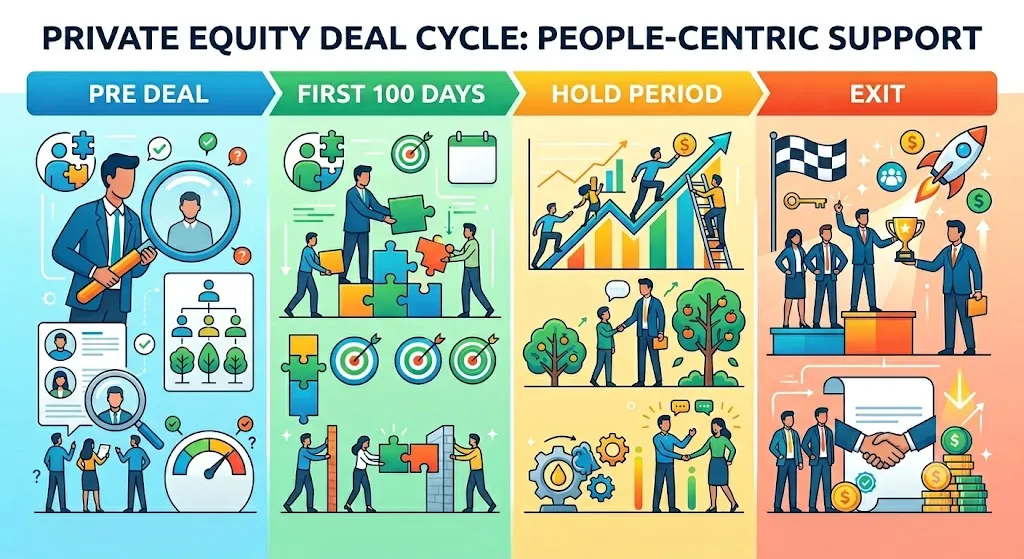
Esbee works at the three points where the people position changes the number: in exclusivity, where it moves price and structure; at execution and through the first hundred days, where TUPE and integration decide whether the synergy case survives contact; and twelve to twenty-four months out from exit, where the same questions arrive from the other side of the table.
Talk to us about a situation →What this means
The work is people due diligence and what follows from it, applied to a portfolio across a hold period. Buy-side, it surfaces management capability, retention exposure, comp architecture and employment liability while there is still a price to be agreed. At execution, it handles the TUPE analysis, the consultation timetable and the integration design that determine whether the operating model the VCP assumed can actually be built. Ahead of exit, it runs the same review from the seller's side and delivers the remediation, so that the buyer's diligence finds resolved matters with dates on them rather than open questions with a price attached. In a PE context people decisions are deal decisions, and the practice treats them that way.
92%
of deal teams said that acting too late on talent contributed to portfolio underperformance across the hold period.
Bain & Company, Global Private Equity Report, 2021
62%
of PE firms now employ a dedicated Human Capital Partner, a measure of how central people work has become to portfolio operations and value creation.
AlixPartners, 10th Annual PE Leadership Survey, 2025
2.2×
the return delivered by firms with well-structured value creation teams, compared with those using traditional portfolio management approaches.
McKinsey & Company, reported 2025
How the work shows up across the deal lifecycle
Stage 1
In diligence
Buy-side people due diligence, scoped to the exclusivity window and written for the investment committee. Management team quality against the plan being underwritten, retention and key-person exposure, comp and incentive architecture, culture and integration risk, and the employment liabilities that are not visible in the accounts. Fixed fee, two to three weeks, with an interim read at the end of week one on anything that moves price or structure.
People due diligence →Stage 2
At execution and post-close
TUPE analysis and consultation on bolt-ons, carve-outs and service provision changes, then Day 1 readiness, org design across the combined business, terms and comp harmonisation, and retention of the people the deal was priced on. This is also where the hold period is decided: the operating model the VCP assumed either gets built in the first hundred days or gets worked around for the next four years.
M&A advisory →Stage 3
Before market
People VDD and the remediation that follows, engaged twelve to twenty-four months out. Management depth strengthened where the plan depends on people who are not yet there, comp rebased, senior matters concluded, live claims closed, and the employment position documented. Buyers price what they discover; the same finding costs materially less when it appears in the vendor pack as a resolved item with a date.
People VDD & exit readiness →Entry point
Portfolio baseline
The pre-exit diligence review run across a portfolio company at the start of a hold period, to establish the employment position that the exit will eventually be measured against and to catch what was inherited from the previous owner. Seven areas, fixed fee, reported as diligence exposure rather than as a compliance score.
Pre-exit people diligence →Working on a deal or in the hold period and want an initial conversation?
Talk to us in confidence →From the casebook
Representative work across the deal cycle. Identifying details changed.
The deal had been modelled on the assumption that the management team would stay
A sponsor brought us in three weeks before an IC presentation to conduct people due diligence on a mid-market business services acquisition. The financial model had been constructed around the existing management team and their client relationships, and the deal thesis depended heavily on leadership continuity through the first two years of the hold period. No structured people review had featured in the diligence process to that point.
The review identified three material findings. The CFO had handed in his notice six weeks earlier, a fact that had not emerged through the financial diligence workstream. Two of the four senior leaders had change-of-control provisions in their contracts that would crystallise on completion and create an immediate cash obligation the model did not account for. And a historical employment tribunal settlement, resolved without admission but with confidentiality provisions, created a reputational exposure the buyer needed to understand before signing.
Findings were presented to the deal team and legal advisers with a recommended commercial response for each. The CFO departure was factored into the retention structure for completion. The change-of-control costs were reflected in the adjusted commercial terms. The historical matter was disclosed to the buyer's legal team with appropriate context, and the risk was managed rather than concealed.
The deal completed on a revised timeline. The sponsor's assessment was that none of the findings would have prevented the transaction, but all of them would have been substantially more expensive to discover after signing.
The value creation plan assumed an operating model the business had already grown past
Eight months into a hold period, the portco's VCP metrics were not tracking and the management team had begun attributing the shortfall to market conditions. The sponsor brought us in to determine whether the business had an execution problem or a structural one, and to make a recommendation before the first formal review with their LP advisory committee.
The operating model diagnostic identified a structural mismatch. The business had grown by roughly 40 per cent since the last formal organisation design work, but the reporting architecture had not been updated to reflect that growth. Regional general managers were carrying spans of control that made active management impractical, and the decisions that drove the highest-value client relationships were being made too far from the people with the authority to act on them. The VCP's commercial growth assumptions had been built on execution capacity the current structure could not reliably deliver.
The engagement redesigned the operating model around the three growth levers the VCP identified as primary: client relationship depth, new logo acquisition, and margin improvement through delivery efficiency. Reporting lines were restructured, a new layer of operational accountability was introduced at the business unit level, and the leadership population work ran alongside the structural changes rather than following them.
VCP metrics began recovering in the quarter following implementation. The sponsor's board pack for the LP advisory review carried a credible narrative about the operational changes and their anticipated effect on the trajectory, rather than a revised set of market-adjusted projections.
Four categories of people risk were resolved before the vendor due diligence pack landed with buyers
A sponsor preparing a portco for a formal sale process brought us in twelve months ahead of the anticipated launch date, recognising that the people and employment position would receive close scrutiny from financial buyers and that unresolved issues would affect either the timeline or the achievable valuation. The instruction was to identify and address anything that would give a diligent buyer cause to reduce price or require indemnities.
The review identified four distinct risk areas. Succession clarity below the CEO was thin, with no documented capability assessment or contingency for the two operationally critical roles. A number of historical employee relations cases had been closed administratively but not formally resolved, leaving residual questions about any outstanding claims. Employment contract documentation across the senior population was inconsistent, with several individuals operating on terms that did not accurately reflect their current responsibilities or compensation arrangements. And key-person concentration in the client base was higher than management had appreciated, creating a risk profile that buyers would price conservatively.
Each category was addressed in sequence over the twelve-month window. Succession documentation was produced, capability assessments were completed, and two internal promotions were made to broaden the visible leadership bench. Historical employee relations matters were formally closed with appropriate documentation. Employment contracts were audited and updated across the affected population. And the client relationship coverage was extended through a structured programme of secondary relationship development, so that no individual held sole contact with accounts above a defined revenue threshold.
The vendor due diligence process completed without material people-related findings. The sale proceeded on the original timeline, and the sponsor avoided the pricing adjustment that unresolved people risk had created in a comparable transaction in their portfolio two years earlier.
How we engage
Engagements are structured around what the deal or the hold period requires, not around a fixed menu of services. Most PE work is project-based: a defined scope, a clear deliverable, and a principal who is accountable for the output throughout. For ongoing portco support during the hold period, we also work on retainer or day-rate arrangements where the HR function is genuinely thin and needs consistent senior input.
Where a portfolio company is operating without a permanent HR leader, or where the existing function lacks the seniority to carry the people chapter of the value creation plan, we provide fractional or interim CHRO-level support on an ongoing basis. This is the engagement model most commonly deployed by value creation teams and portfolio operations functions where consistent, board-level HR presence is needed without the cost or process of a permanent hire. The human capital partner role that larger funds typically employ in-house is the function we provide on a fractional basis for sponsors operating at the lower and mid-market end.
Sam Bramhall has spent the better part of six years working inside PE-backed businesses at board level, across deal types and hold periods from platform acquisition through exit preparation. The work at Esbee builds directly on that operational experience. The difference between PE advisory that works and advisory that does not is usually whether the adviser understands what the inside of a portco actually looks like under hold period pressure. The EBITDA bridge and the people plan are the same document, and the work is approached accordingly.
Confidentiality is handled as a matter of course. Most of the situations we work on are not known to the wider management team, the portfolio company employees, or in some cases to anyone outside the IC. We operate with the same information discipline that the deal process itself requires.
The North West, Yorkshire and the West Midlands
Esbee works primarily with PE firms, portfolio companies, and deal advisers across the North West, Yorkshire, and the West Midlands, with Liverpool, Manchester, Leeds, and Birmingham as the principal deal hubs. The lower and mid-market buyout activity across these three regions generates the kinds of people and operational situations that the practice is structured to address, and the principal-led engagement model works particularly well where the fund, the portfolio company, and the adviser group are operating within the same regional deal community rather than through a London intermediary.
Esbee's engagement with the regional deal community operates through personal introduction and established relationships rather than through public channels, covering Liverpool, Manchester, Leeds, and Birmingham. If you are a corporate finance adviser, accountant, or deal lawyer with a fund or portfolio company to introduce, a direct approach at info@esbeehr.co.uk is the right starting point.
The practice is led by Sam Bramhall.
Sam Bramhall is the Principal Consultant at Esbee, with two decades of board-level strategic HR and organisational advisory across telecoms, fintech, professional services, technology, and PE-backed businesses. Engagements are principal-led: you work directly with Sam throughout, not with a junior team managing upward.
About Sam and the firm →Frequently asked questions
- At what stage in the deal process should we bring you in?
- In exclusivity, and ideally at the start of it rather than in the last fortnight. The common pattern is engagement post-IC, when the structure is largely set and the people questions have already been constrained by commercial decisions that were taken without them. A finding that would have moved price is worth considerably less once price is agreed. For bolt-ons and carve-outs in particular the people position affects deal structure rather than only implementation.
- Do you work at the firm level or the portco level?
- Both, depending on what the situation requires. For pre-deal work, we typically work alongside the deal team and the firm's adviser group. For portco work, we engage directly with the management team, usually acting as the de facto HR function or working alongside the CHRO where one exists. The engagement model depends on the portco's maturity, the stage of the hold period, and what the VCP requires.
- Can you manage a TUPE transfer as part of an integration?
- Yes. TUPE is a structural constraint in most bolt-on and carve-out integrations, and the sequencing of people decisions around it determines a significant portion of the integration timeline. We handle the TUPE consultation process, advise on measures and election procedures, and integrate TUPE compliance into the operating model design rather than treating it as a separate compliance track.
- How do you handle situations where portco management does not know a deal is in progress?
- Carefully, and with a clear distinction between what we can do pre-completion and what becomes necessary post-completion. Pre-completion, we work on the information available under confidentiality with the deal team. We do not interact with portco management until the deal structure and confidentiality approach permit. Post-completion, we can move quickly on communication and integration work precisely because the preparation has been done in advance.
- What is your experience in PE-backed businesses specifically?
- Sam Bramhall has spent the better part of six years working inside PE-backed businesses at board level, across deal types and hold periods from platform acquisition through exit preparation. That is operational experience, not advisory work observed from the outside. The practical difference is understanding that the EBITDA bridge and the people plan are the same document, and that the VCP either has a credible people chapter or it does not.
- How does engagement pricing work?
- Fixed fee for defined-scope work: buy-side diligence, integration planning, people VDD. Retainer or day rate for ongoing portfolio company support across a hold period. The commercial structure is agreed at briefing and does not move once work is underway. For deal-sensitive work it can sit within a deal team fee arrangement where that is how the firm accounts for diligence costs.
Where this work happens in the practice
In diligence
People Due Diligence
Buy-side: management quality, retention exposure, comp architecture, integration risk and employment liability. Fixed fee, scoped to exclusivity.
At execution
M&A Advisory
TUPE on bolt-ons and carve-outs, Day 1 readiness, org design across the combined business, harmonisation, and retention.
Before market
People VDD & Exit Readiness
The sell-side assessment and the remediation that follows, twelve to twenty-four months ahead of the process.
Entry point
Pre-Exit People Diligence
The seven-area review, run as a portfolio company baseline or as the first step in exit preparation.
Last reviewed: May 2026


For advisers
If you act for a business — as a corporate finance or legal adviser — where a people question sits between your client and a deal, or between a portfolio company and its plan, we are straightforward to introduce. The relationship stays yours. We take the people dimension, work to the deal's timetable, and report in the way the process requires.
Introduce a client →Confidential conversation
If you are a PE firm or portfolio company leadership team facing a people question that matters to the deal, we welcome a conversation. All initial discussions are confidential.
Get in touch